
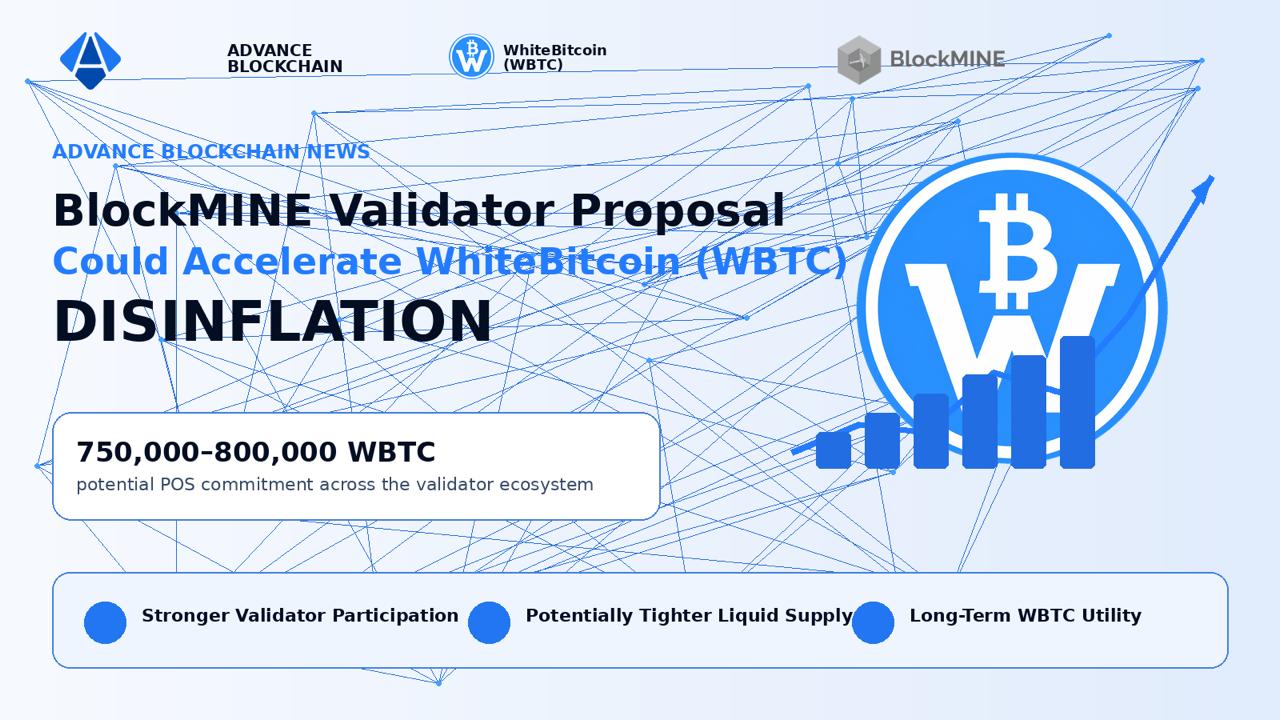
BlockMINE’s Seven-Validator Model May Place Up to 800,000 WBTC Into Proof-of-Stake Participation Across ABC20
August 29, 2026 — Advance Blockchain (ABC20)
Advance Blockchain (ABC20) is moving into a broader validator-development phase as BlockMINE prepares a multi-validator infrastructure strategy built around WhiteBitcoin (WBTC), the native asset of the Advance Blockchain ecosystem.
The planned BlockMINE structure is expected to operate seven validator categories, each designed to support network participation through significant WBTC Proof-of-Stake commitments.
Based on the proposed allocation model, the combined validator commitment could reach approximately 750,000 to 800,000 WhiteBitcoin.
If the strategy is deployed at that scale, BlockMINE could become one of the largest validator-based WBTC participation structures within Advance Blockchain.
BlockMINE’s Planned WBTC Validator Commitments
The proposed validator framework includes a substantial WhiteBitcoin allocation across the BlockMINE ecosystem.
The structure is expected to include:
- more than 150,000 WBTC for the BlockMINE Prime Validator,
- approximately 100,000 WBTC for BlockMINE 2030,
- and additional validator categories with allocations approaching 100,000 WBTC each.
Combined, these positions could bring the total validator-side WBTC commitment toward the 750,000–800,000 WBTC range.
That scale is significant because WhiteBitcoin is not simply an external staking asset. WBTC is the native coin of Advance Blockchain (ABC20) and plays a direct role in network activity, validator participation, transactions, smart contracts, decentralized applications and broader ecosystem utility.
Why 750,000–800,000 WBTC Matters
Using approximately 17.5 million WBTC as the circulating-supply reference, the planned validator commitment could represent a meaningful percentage of current supply.
A 750,000 WBTC position would equal approximately 4.29% of circulating supply. An 800,000 WBTC position would equal approximately 4.57% of circulating supply.
That means a single validator ecosystem could potentially place more than four percent of current WhiteBitcoin supply into validator-related participation.
This does not mean those WBTC permanently leave circulation. However, WBTC allocated to Proof-of-Stake positions may become less immediately available for open-market trading. That distinction could become increasingly important as validator activity expands.
Circulating Supply vs. Liquid Supply
One of the most important concepts in digital-asset markets is the difference between circulating supply and liquid supply.
Circulating supply measures how many coins are already distributed and considered active. Liquid supply refers more specifically to the amount of that asset that may actually be available for buying and selling at a given time.
If 750,000 to 800,000 WBTC is committed to BlockMINE Validators, part of the circulating supply could move into longer-term validator participation.
- 17.5 million WBTC − 750,000 WBTC = approximately 16.75 million WBTC
- 17.5 million WBTC − 800,000 WBTC = approximately 16.70 million WBTC
These numbers should not be interpreted as guaranteed market liquidity figures. They illustrate the potential scale of WBTC that could shift away from immediate market availability.
A Potential Disinflationary Effect on WhiteBitcoin Liquidity
The BlockMINE Validator strategy does not automatically change WhiteBitcoin’s predetermined mining or issuance schedule. That is an important technical distinction.
However, the validator model could influence effective market supply. If substantial quantities of WBTC move into validator Proof-of-Stake commitments, the amount of WhiteBitcoin readily available for short-term market activity may decrease.
This can create what may be described as a liquidity-based disinflationary effect. The protocol may continue issuing WBTC according to its existing supply schedule, while validator participation reduces the portion of WBTC immediately available in the market.
This difference is important for investors, delegators and ecosystem participants evaluating WhiteBitcoin’s future supply structure.
Delegators Could Add a Second Layer of WBTC Demand
The BlockMINE model is not designed around validators alone. It also introduces a broader delegator participation layer.
Delegators can participate in selected validators by allocating WhiteBitcoin to validator infrastructure rather than running validator operations directly.
That means WhiteBitcoin demand could potentially develop across two distinct channels.
1. Validator Capital Requirements
BlockMINE Validators may require significant WBTC commitments for Proof-of-Stake participation and network operation.
2. Delegator Participation
External WBTC holders or new participants may acquire WhiteBitcoin for the purpose of delegating it to selected BlockMINE Validators.
If both channels grow together, validator-driven WBTC demand could extend beyond the initial 750,000–800,000 WBTC allocation.
WhiteBitcoin Utility Could Expand Alongside Validator Growth
WhiteBitcoin already serves as the native economic asset of Advance Blockchain. Validator expansion could deepen that utility.
WBTC may increasingly be used across:
- Proof-of-Stake participation,
- validator commitments,
- delegation,
- transaction fees,
- smart-contract activity,
- decentralized finance,
- decentralized applications,
- payments,
- and network-level ecosystem participation.
The more WBTC is actively used inside Advance Blockchain, the greater the distinction may become between coins simply circulating and coins actively committed to network utility.
What Could This Mean for WhiteBitcoin Market Liquidity?
The effect of validator demand on WhiteBitcoin pricing cannot be calculated with a simple formula.
Digital-asset price discovery depends on several variables, including:
- open-market liquidity,
- trading volume,
- buyer activity,
- seller activity,
- order-book depth,
- validator demand,
- delegation demand,
- ecosystem growth,
- and broader market conditions.
However, one principle remains relevant. If demand increases while immediately available supply decreases, market liquidity can become tighter.
If BlockMINE Validators require hundreds of thousands of WBTC and delegators simultaneously acquire additional WhiteBitcoin, competition for available supply could increase.
The actual market impact would depend heavily on how much WBTC is genuinely available for sale.
Why Market Depth Matters More Than Total Supply Alone
A circulating supply figure does not reveal how much WBTC is actually available at current market prices.
Some WBTC may be:
- held long term,
- committed to validators,
- delegated,
- used in DeFi,
- held in wallets,
- or otherwise inactive in short-term trading.
Therefore, even though approximately 17.5 million WBTC may be circulating, the amount actively offered for sale could be significantly lower.
If validator and delegator demand begins absorbing available liquidity, buyers may eventually need to transact across higher price levels. This is one reason validator infrastructure could become increasingly relevant to WhiteBitcoin market structure.
BlockMINE Commitments Could Represent Nearly 4% of Maximum WBTC Supply
WhiteBitcoin has a long-term maximum supply framework of 21 million WBTC.
Against that maximum supply, 750,000 WBTC equals approximately 3.57% and 800,000 WBTC equals approximately 3.81%.
This means BlockMINE Validator participation alone could potentially account for a substantial percentage of WhiteBitcoin’s eventual maximum supply.
If additional delegator commitments are added, the total WBTC involved in validator participation could become even larger.
Seven Validators Could Strengthen Advance Blockchain Infrastructure
The validator expansion also carries implications beyond supply economics.
Validators are essential to Advance Blockchain because they help support:
- transaction validation,
- network security,
- Proof-of-Stake consensus,
- blockchain reliability,
- and broader decentralized participation.
A seven-validator BlockMINE structure could add another layer of infrastructure to the ABC20 ecosystem.
As WBTC participation increases, validator development may strengthen both the technical and economic relationship between WhiteBitcoin and Advance Blockchain.
The Importance of Long-Term Validator Participation
Validator infrastructure is generally more meaningful when participation is sustained rather than short term.
If significant WBTC amounts remain committed across validators over extended periods, Advance Blockchain could experience a more stable validator base.
That could support network resilience, higher Proof-of-Stake participation, greater WBTC utility, reduced short-term liquid float and stronger ecosystem alignment.
The interaction between these factors may become increasingly important as the Advance Blockchain ecosystem develops.
BlockMINE Could Become a Major WhiteBitcoin Utility Layer
The BlockMINE Validator initiative represents more than a validator deployment. It could become a major utility layer for WhiteBitcoin.
Through validator commitments and delegation, WBTC can move from being simply held or traded into being actively used for network infrastructure. This can strengthen the relationship between asset ownership and blockchain participation.
For Advance Blockchain, that means WhiteBitcoin may increasingly serve several roles simultaneously:
- native transaction asset,
- network-security asset,
- validator participation asset,
- delegation asset,
- and ecosystem utility asset.
What Should the Market Watch Next?
As BlockMINE Validator infrastructure develops, several data points could become important indicators of WhiteBitcoin network participation.
Market observers may want to monitor:
- total WBTC committed across BlockMINE Validators,
- total WBTC delegated by external participants,
- number of active delegators,
- percentage of circulating WBTC committed to validators,
- Advance Blockchain validator activity,
- available WBTC market liquidity,
- WhiteBitcoin trading volume,
- and changes in WBTC price discovery.
If BlockMINE commitments approach the proposed 750,000–800,000 WBTC range, the validator ecosystem could represent one of the more significant uses of WhiteBitcoin within Advance Blockchain.
A New Supply-and-Utility Phase for WhiteBitcoin
The expansion of BlockMINE Validators could mark a new stage in the economic development of WhiteBitcoin.
The key issue may no longer be only how much WBTC is circulating. How much WhiteBitcoin remains liquid once validators, delegators and ecosystem applications begin using a larger share of the available supply?
If validator commitments increase while delegator participation expands, WhiteBitcoin could experience a tighter effective liquid supply at the same time that its utility across Advance Blockchain grows.
That combination could become an important factor in the future development of WhiteBitcoin liquidity, validator economics and WBTC price discovery.
Risk Disclosure
WhiteBitcoin and other digital assets can experience significant price volatility. Validator participation, Proof-of-Stake commitments, delegation, reduced liquid supply or increased ecosystem utility do not guarantee higher WBTC prices. This article is intended for informational purposes only and should not be considered financial or investment advice.
